Why Does Your Jungian Shadow Show Up as a Snake in One Dream and a Zombie in the Next?
Unveiling the Shadow: A Jungian Exploration of Dreams and the Unconscious Self
The Core Essence of the Jungian Shadow in Dreams
Carl Jung’s concept of the Shadow is arguably one of his most profound contributions to analytical psychology, offering a powerful lens through which to understand the human psyche, particularly as it manifests in our dreams. At its core, the Shadow represents the unknown side of the personality – everything that the conscious ego does not identify with. This can encompass not only the negative or undesirable traits and impulses that we repress or deny, but also unexpressed positive qualities, such as spontaneity, intuition, or creativity, which for various reasons have been relegated to the unconscious.
In the individual unconscious, the Shadow operates as a dynamic, autonomous complex. It's not merely a passive repository of forgotten memories but an active psychological entity that constantly seeks expression. When aspects of the Shadow are consistently ignored or suppressed by the ego, they don't simply vanish; instead, they gather energy and often find an outlet through projections onto others or, more significantly for our discussion, through dreams. Dreams, for Jung, are the royal road to the unconscious, offering symbolic narratives that reveal the hidden dynamics of the psyche. The dream often acts as a compensatory mechanism, striving to bring unconscious material into conscious awareness to restore psychological balance.
The underlying psychological principle of the Shadow's manifestation in dreams is that the unconscious attempts to communicate what the conscious mind is avoiding or has not yet integrated. The dream-ego encounters figures or situations that embody these unacknowledged parts. For instance, if a person prides themselves on their kindness but unconsciously harbors resentment, their Shadow might appear in a dream as a cruel or aggressive individual. This isn't an arbitrary image; it's a precisely crafted symbol from the deeper layers of the psyche, designed to confront the dreamer with their hidden truth.
As an archetype, the Shadow is a universal pattern of the human experience, an inherited predisposition to form certain images or ideas about the 'dark side' of human nature. While the content of each individual's Shadow is unique, the form of encountering an unacknowledged part of oneself is archetypal. It stands in a crucial dialectical relationship with the ego, which is the center of consciousness. The ego often resists recognizing the Shadow because doing so challenges its carefully constructed self-image. However, the path to psychological wholeness, or individuation, requires a conscious confrontation and eventual integration of the Shadow, allowing its energies to be harnessed constructively rather than remaining as destructive, unconscious forces. Understanding these fundamental archetypes is key to interpreting our inner world. For a broader perspective on Jungian concepts, you might explore The Master Encyclopedia of Dreams.
Sensory Practice: Identifying the Shadow in Your Dreams
Identifying the Shadow in your dreams requires a keen eye for symbolism and a willingness to confront uncomfortable truths. The Shadow rarely appears explicitly labeled; instead, it adopts various disguises. Common manifestations include figures that evoke strong negative emotions – fear, disgust, anger, or even intense fascination. These might be a menacing stranger, a criminal, a deceitful acquaintance, or someone embodying traits you despise in others but secretly possess yourself. For example, a person who always strives for perfection might dream of a lazy or incompetent character, reflecting their repressed impulses to relax or make mistakes without guilt. Often, the gender of the Shadow figure in dreams will correspond to the dreamer's own gender, as it represents the rejected aspects of one's personal identity. However, this isn't always a strict rule; the Shadow can take on many forms.
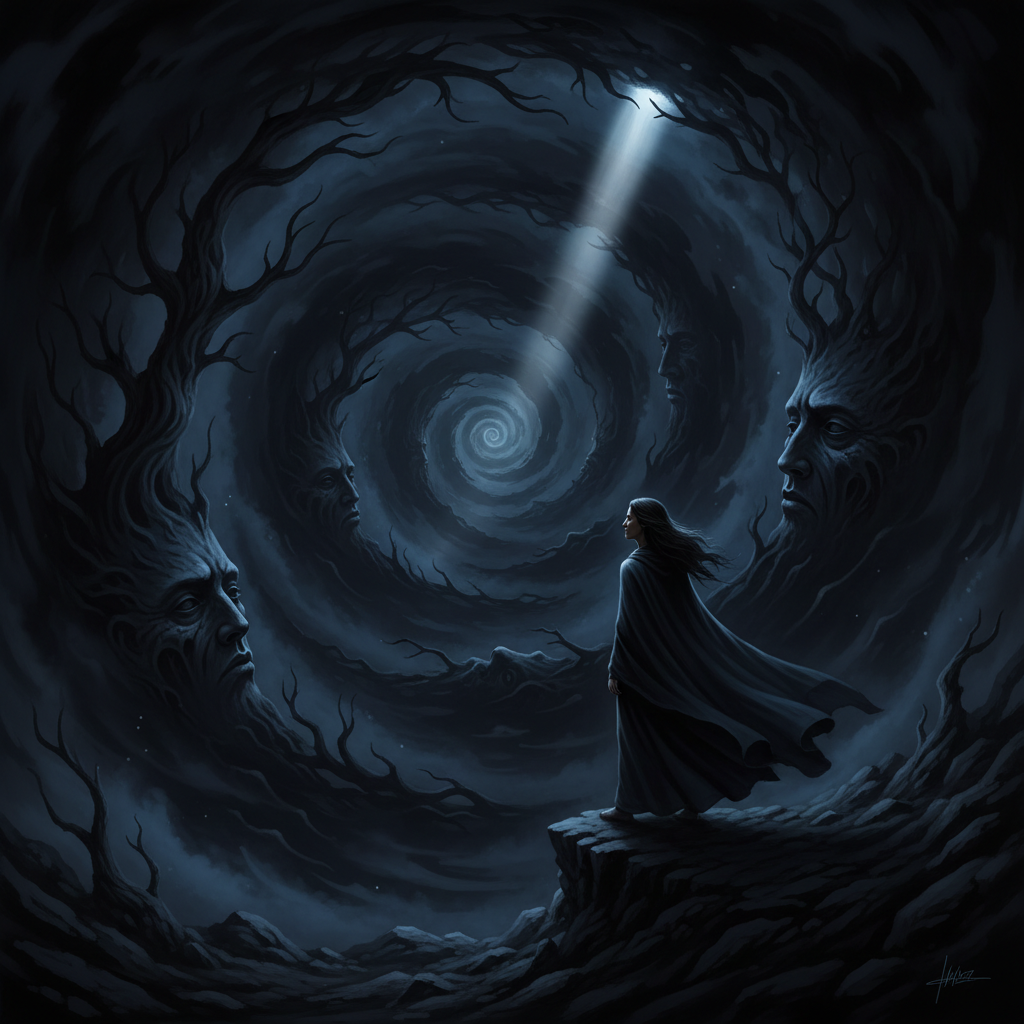
Beyond human figures, the Shadow can manifest as specific animals, particularly those associated with primal instincts or perceived negative qualities: a venomous snake, a ravenous wolf, or a cunning fox might symbolize repressed aggression, sexuality, or deceit. Even inanimate objects or unsettling environments can carry the energy of the Shadow, such as a decaying building, a dark alley, or a hidden, squalid room. Perhaps one of the most striking forms of the Shadow in dreams, as noted in Jungian analyses, can be "undead" creatures like zombies or vampires. These figures can symbolize aspects of the self that are denied vitality, unintegrated parts that are "living" in the unconscious but are not yet fully alive or recognized by the ego, often carrying a sense of being consumed or controlled by something outside conscious will.
To practically identify and understand your personal Shadow in a dream, consider these steps: Firstly, pay close attention to any character or element in your dream that causes strong aversion, fear, or moral judgment. Ask yourself: "What traits does this figure embody that I dislike or disown in myself?" Secondly, observe your reactions in the dream. Are you running away, fighting, or trying to ignore it? Your dream-ego's behavior can offer clues about your waking ego's relationship with these repressed aspects. Thirdly, engage with the figure, even if only mentally, after waking. What message might it be trying to convey? What part of you does it represent? Dream analysis isn't about literal interpretation but about uncovering symbolic meanings. The goal isn't to eliminate the Shadow but to recognize its presence and integrate its energy. Learning to see the Shadow not as purely evil, but as an unacknowledged part of the self, is a crucial step towards psychological wholeness. This journey starts with understanding its various guises, as further detailed in discussions like Jungian Psychology Series: The Shadow.
Comparative Analysis: Jungian Shadow vs. Other Dream Theories
While both Carl Jung and Sigmund Freud recognized the profound significance of dreams, their interpretations of dream content, especially concerning unsettling figures like the Shadow, diverged considerably. Freud, with his emphasis on the unconscious as a repository of repressed sexual and aggressive wishes, viewed dreams primarily as wish fulfillment, albeit often disguised and symbolic. His famous distinction between manifest (what you remember) and latent (the hidden meaning) dream content sought to uncover these primal urges. For Freud, a disturbing dream figure might symbolize a repressed desire or a punitive superego, rooted in early childhood experiences and psychosexual development.
Jung, however, moved beyond this reductionist view. While acknowledging personal complexes, he posited a deeper, collective unconscious populated by universal archetypes, of which the Shadow is one. For Jung, the dream doesn't just reveal repressed desires; it offers compensatory insights and guidance for the dreamer's journey towards individuation. The dream's purpose is not merely to express a disguised wish but to communicate a message essential for the conscious attitude. Therefore, a dream figure representing the Shadow isn't just a symbol of a repressed sexual urge, but a living, dynamic aspect of the self that needs recognition and integration for psychological growth. It’s an aspect that contains vitality and potential, even if it appears in a frightening guise.
This distinction is crucial when comparing the Jungian Shadow to the popular understanding of "nightmares" or simply "bad dreams." In common parlance, nightmares are often dismissed as mere products of anxiety, stress, or even indigestion – something to be forgotten or avoided. From a Jungian perspective, however, a dream involving an encounter with the Shadow, no matter how terrifying, is rarely "just" a bad dream. Instead, it’s a psychologically potent experience, a direct communication from the unconscious, often signaling that a crucial aspect of the self has been ignored, disowned, or projected onto others. The 'badness' of the dream often correlates with the degree of the ego's resistance to acknowledging the Shadow.
The Jungian Shadow is not inherently "evil" in a moral sense, although it often embodies traits society deems negative. Rather, it represents the raw, uncivilized, and unintegrated parts of the self. To encounter the Shadow in a dream is not a sign of impending doom, but an invitation for self-discovery and psychological growth. It's an opportunity to reclaim projected parts of oneself, to understand one's motivations more deeply, and ultimately, to move towards a more complete and authentic self. Through understanding and integrating these previously unacknowledged parts, we move beyond the superficial judgment of "good" and "evil" to a more nuanced appreciation of human complexity. This process allows for the absorption of vital energy and creativity that was previously locked away, as explored in articles discussing The Jungian Shadow Archetype and Dreams.
Real-world Cases: Facing the Shadow for Psychological Growth
The powerful impact of the Shadow manifesting in dreams is best understood through real-world examples, both from clinical practice and personal anecdotes. One common scenario involves recurring dreams where the dreamer is relentlessly pursued by a dark, unknown figure. In analysis, this figure often personifies the dreamer's own repressed anger, anxiety about failure, or even a hidden desire they deem unacceptable. For instance, a highly successful businessman who prided himself on his ethical conduct might repeatedly dream of being chased by a shady character trying to defraud him. This could symbolize his own repressed aggressive competitiveness or his subconscious fear of his own capacity for moral compromise, parts of himself he vehemently disavows in his waking life. The persistent nature of such dreams indicates the urgency with which the unconscious seeks attention for this unacknowledged aspect.
Another classic manifestation is the dream of performing an act contrary to one's conscious values. A person who identifies as deeply compassionate might dream of being cruel to an animal or neglecting a loved one. Initially, such dreams can cause immense guilt and confusion. However, from a Jungian perspective, these dreams are not literal prophecies of behavior, but symbolic representations of repressed parts of the psyche. They challenge the ego's one-sided self-perception and invite the dreamer to acknowledge the full spectrum of human emotions and potentials within themselves – including those they consider "bad." Recognizing that these impulses exist, even if never acted upon, is the first step towards integrating them and consciously choosing how to express or transform their energy.
Historical figures and personal accounts also offer compelling evidence. For instance, many artists and writers have spoken of confronting their inner "demons" or "muses" through dream imagery, which can be interpreted as encounters with their Shadow. Robert Louis Stevenson’s famous story, "Strange Case of Dr. Jekyll and Mr. Hyde," is often cited as a powerful literary representation of the Shadow, depicting the struggle between the conscious ego (Jekyll) and the repressed, darker aspects of the personality (Hyde) which eventually overwhelms him. While not a direct dream, it mirrors the psychological dynamic that plays out in many individuals' nighttime experiences. These narratives underscore the idea that ignoring the Shadow does not make it disappear; it merely allows it to operate autonomously and potentially destructively from the unconscious.
The journey of facing the Shadow in dreams is not about succumbing to its negative aspects but about integrating its energies into a more complete sense of self. Through conscious engagement with these challenging dream figures – asking what they represent, understanding their origins, and recognizing them as parts of oneself – individuals can achieve profound psychological growth. This process of acknowledging and assimilating the Shadow transforms it from a menacing force into a source of vitality and authenticity, leading to greater self-awareness and inner harmony. The true purpose of these often-unsettling dreams is to encourage us to confront our inner landscape, ultimately contributing to a more psychologically whole and integrated personality. This perspective reframes what many consider 'bad dreams' into powerful opportunities for self-discovery, aligning with insights found in The Shadow Self: Bad Dreams Explored from a Jungian Perspective.